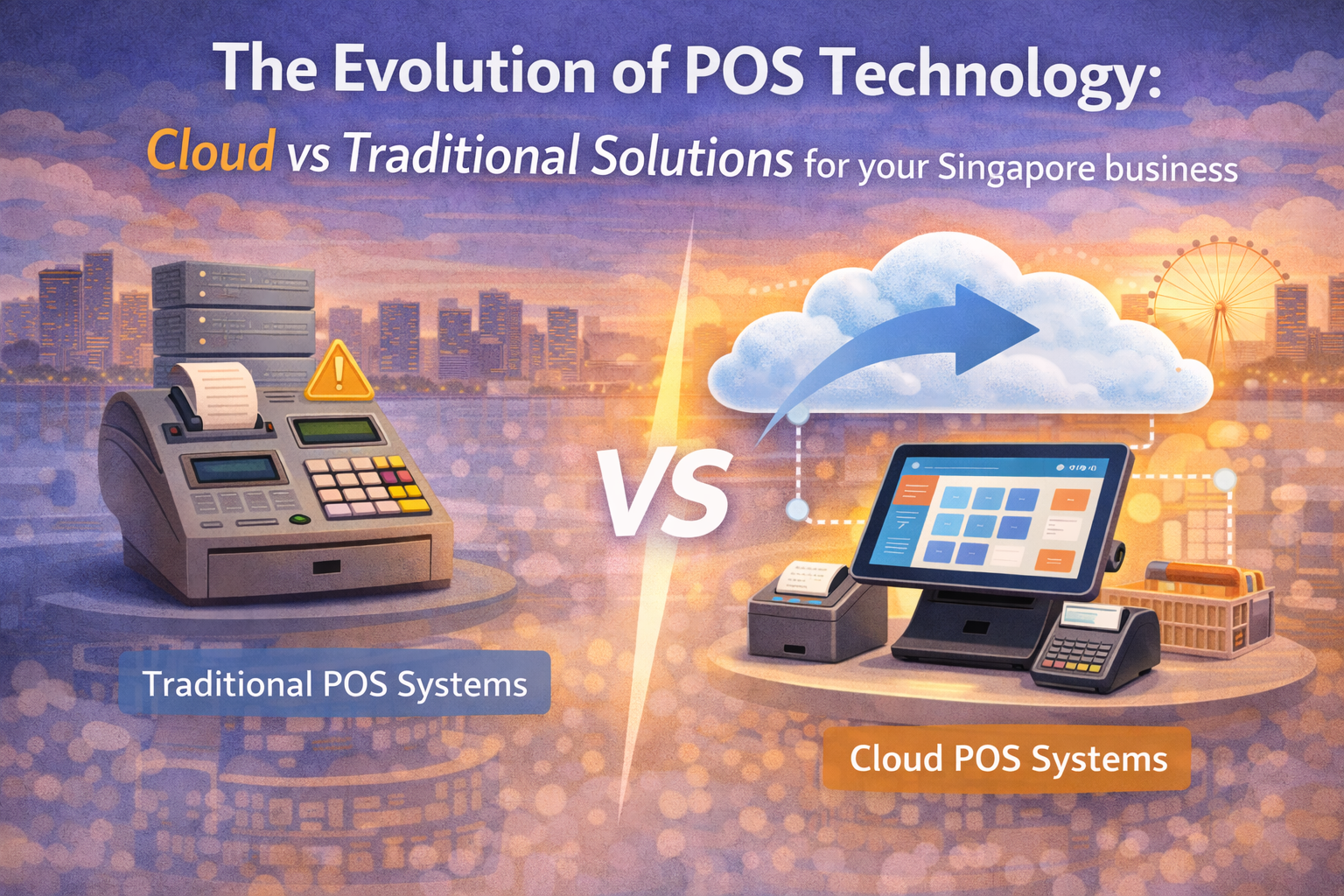
The Evolution of POS Technology: Cloud vs Traditional Solutions for your Singapore business
The point-of-sale system in your retail store or F&B outlet is far more than just a cash register. Today’s POS technology has evolved from simple transaction recorders into sophisticated business management platforms that can make or break your operational efficiency. For Singapore business owners navigating the city-state’s highly competitive and digitally advanced market, understanding this evolution and choosing between cloud-based and traditional POS systems is crucial for long-term success.
Singapore’s retail and F&B sectors are experiencing rapid digital transformation, with the F&B services market alone projected to grow from US$22.33 billion in 2024 to US$87.12 billion by 2033. The number of POS terminals in Singapore is expected to reach approximately 392,280 units by 2028, reflecting a compound annual growth rate of 2.64%. This growth is driven by increasing digital payment adoption, government support through initiatives like the Smart Nation programme, and evolving consumer expectations for seamless, cashless transactions.[2]
As Singapore businesses face mounting pressure to digitalise, the choice between traditional and cloud-based POS systems has become a strategic decision that impacts everything from daily operations to long-term scalability.
From Mechanical Registers to Digital Intelligence: The POS Journey
The story of point-of-sale technology begins not in Silicon Valley, but in a Dayton, Ohio saloon in 1879. James Ritty, a saloon owner frustrated by employee theft, invented what he called “Ritty’s Incorruptible Cashier”—the world’s first mechanical cash register. Inspired by a ship’s propeller counter during a European voyage, Ritty and his brother John created a device with a dial showing dollars and cents, allowing owners to track daily sales totals and detect discrepancies.[3][4][5]
The invention was revolutionary but rudimentary. There was no cash drawer initially, no receipt printer, just a running tally and a bell that rang with each transaction—the origin of the iconic “ka-ching” sound. Despite its limitations, Ritty’s invention laid the foundation for an entire industry.[6][7]
The next major leap came in the 1970s when IBM introduced electronic cash registers. In 1973, IBM launched the 3650 and 3660 Store Systems, the first commercial electronic POS systems that replaced mechanical parts with microprocessors and memory. These machines could track transactions, run price lookups, and generate early sales reports—capabilities that revolutionized retail operations, particularly in supermarkets.
The 1980s saw rapid evolution with computerized POS systems that could connect to barcode scanners and printers. By 1986, touchscreen technology entered the scene, making systems more intuitive. The 1990s brought complete software suites that managed everything from sales to inventory in integrated platforms.
However, the most transformative change came in the 2010s with the rise of cloud-based POS systems. As internet connectivity became reliable and affordable, cloud systems fundamentally changed the POS landscape by storing data securely online rather than on local servers, enabling real-time access from anywhere and automatic updates.[14]
Understanding Traditional POS Systems: The Legacy Approach
Traditional POS systems, also known as legacy or on-premise systems, are locally installed solutions that run on closed internal networks with data stored on local servers or hard drives. Think of them as standalone computers dedicated solely to your business operations at a specific location.
Architecture and Components
A traditional POS setup typically includes specialized hardware: dedicated POS terminals, cash drawers, receipt printers, barcode scanners, and a back-office server. The software is installed directly on these devices, and all transaction data, inventory records, and customer information are stored locally.
Key Characteristics
Traditional systems operate independently of internet connectivity, making them inherently reliable during network outages. They process transactions locally, which can mean faster response times since they don’t rely on external servers. Updates and maintenance require manual intervention, often necessitating on-site technical support.
Cost Structure
The investment model for traditional POS differs significantly from cloud alternatives. In Singapore, initial hardware costs for traditional systems typically range from S$2,600 to S$7,500 per terminal, with total setup costs potentially exceeding S$11,500. This represents a substantial upfront capital expenditure but eliminates ongoing subscription fees.
Advantages
For businesses with stable operations in areas with unreliable internet, traditional systems offer genuine benefits. They provide complete control over data, which some owners find reassuring from a security perspective. Since there’s no dependence on external cloud providers, businesses aren’t vulnerable to service outages from third-party platforms.[24]
The one-time purchase model can also appeal to businesses that prefer to avoid recurring monthly fees, potentially offering better long-term cost predictability.
Limitations
However, traditional systems come with significant constraints that increasingly challenge modern business requirements. High upfront costs create barriers for startups and small businesses. The systems are tied to specific physical locations, preventing remote access to sales data, reports, or system management.
Scalability presents another challenge. Adding new locations requires purchasing entirely new hardware setups and manually configuring each system. Updates must be installed manually, often requiring technical expertise and scheduled downtime.
Data loss risks are substantial. Since everything is stored locally, hardware failures, theft, or disasters can result in complete data loss unless robust backup systems are in place. Integration with modern tools like e-commerce platforms, accounting software, or third-party applications is often limited or impossible.
Cloud-Based POS Systems: The Modern Standard
Cloud-based POS systems represent a fundamental shift in how business technology operates. Also called Software-as-a-Service (SaaS) POS or mobile POS, these systems run entirely online with data stored securely on remote servers.
How Cloud POS Works
Instead of installing software on specific devices, you access the POS through web browsers or apps on various devices—tablets, smartphones, laptops, or desktop computers. When a transaction occurs, data is instantly transmitted to and stored on cloud servers, making it accessible from any internet-connected device.[14]
Cost Structure
Cloud POS systems dramatically reduce upfront investment. In Singapore, tablet-based terminals cost approximately S$400 to S$1,000 each, compared to S$2,600 to S$7,500 for traditional terminals. Instead of large capital expenditures, businesses pay monthly or annual subscription fees, typically ranging from S$150 to S$500+ depending on features and scale.
For Singapore SMEs, BigPOS offers tailored packages including BIG POS Lite for smaller operations and BIG POS Pro for comprehensive retail and F&B management. This subscription model converts technology costs from capital expenditure to operational expenditure, easing cash flow management for SMEs.
Core Benefits
Real-Time Accessibility: Cloud systems allow business owners and managers to access sales data, inventory levels, and performance reports from anywhere at any time. This is transformative for multi-location operations or owners who travel frequently.
Automatic Updates: Software updates, security patches, and new features are deployed automatically by the provider, eliminating manual update processes and ensuring you’re always running the latest version.
Scalability: Adding new locations, employees, or features is remarkably simple with cloud systems. There’s no need to purchase and configure new hardware for each expansion—just add new user accounts or devices to your existing system.
Superior Data Security: Contrary to common misconceptions, cloud systems often provide better security than local storage. Enterprise-grade 256-bit encryption, automatic data backups with geographically dispersed storage, and compliance with Singapore’s Personal Data Protection Act (PDPA) are standard features.
Advanced Analytics: Cloud POS systems provide sophisticated reporting and analytics capabilities, offering insights into sales trends, inventory turnover, employee performance, and customer behavior in real-time.
Integration Capabilities: Modern cloud systems integrate seamlessly with accounting software like Xero and QuickBooks, e-commerce platforms, payment gateways including PayNow and SGQR, inventory management tools, and customer relationship management (CRM) systems.[35][36][37]
Mobile Functionality: Cloud POS enables mobile transactions through tablet-based systems, allowing staff to serve customers tableside or on the shop floor, reducing queues and improving customer experience. This is particularly valuable in Singapore’s F&B sector where space is at a premium. Solutions like BIG Waiter enable servers to take orders directly at the table on mobile devices, sending them instantly to the kitchen via integrated KDS (Kitchen Display Systems), eliminating paper tickets and reducing order errors.[38][35]
Considerations and Limitations
Cloud systems do require stable internet connectivity for optimal operation. However, most modern cloud POS systems now include offline modes that allow transactions to continue during internet outages, with automatic synchronization once connectivity is restored.[39][40][42]
The subscription model, while reducing upfront costs, represents an ongoing operational expense that accumulates over time. Some business owners also express preference for maintaining local control over their data, though cloud providers typically offer stronger security than most businesses can implement independently.
Head-to-Head Comparison: Cloud vs Traditional POS
Initial Investment
Traditional POS systems require substantial upfront capital, often exceeding S$10,000 for a complete setup in Singapore. Cloud POS systems typically cost under S$2,000 for initial hardware with minimal setup fees.
Operational Costs
Traditional systems incur maintenance costs, manual update fees, and potential repair expenses but no subscription fees. Cloud systems involve monthly subscriptions ranging from S$150 to S$500+ but include automatic maintenance and updates.
Data Accessibility
Traditional systems confine data access to physical business locations. Cloud systems provide real-time access from anywhere with internet connectivity.
Scalability
Expanding traditional systems requires purchasing complete new hardware setups for each location. Cloud systems allow instant scalability by simply adding user accounts or devices.
Integration
Traditional systems offer limited or no integration with modern business tools. Cloud systems integrate seamlessly with e-commerce, accounting, inventory, and payment platforms.[37][35]
Security and Backup
Traditional systems store data locally, creating risks of complete loss from hardware failure or disasters. Cloud systems provide automatic encrypted backups with geographically distributed redundancy.
Offline Functionality
Traditional systems operate fully offline without internet dependence. Cloud systems require connectivity but most now include offline modes for transaction continuity.[40]
Update Management
Traditional systems require manual updates, often needing technical support and scheduled downtime. Cloud systems deploy updates automatically without user intervention.
Hardware Flexibility
Traditional systems depend on specialized proprietary hardware. Cloud systems run on various devices including tablets, smartphones, and computers.
Singapore-Specific Considerations for POS Selection
Regulatory Compliance
Singapore businesses must navigate specific regulatory requirements that impact POS system selection. The GST InvoiceNow Requirement, progressively mandatory from November 2025, requires businesses to transmit invoice data to IRAS using InvoiceNow-Ready Solutions via the Peppol network. This requirement favours cloud-based systems with built-in API connections to government systems.[43][44]
Cloud POS providers are increasingly offering InvoiceNow integration, enabling automatic transmission of invoice data to IRAS while routing invoices to customers through the Peppol network. Traditional systems may struggle to implement these integrations without expensive custom development.[43]
Payment Integration
Singapore’s digital payment ecosystem requires POS systems to support multiple payment methods. PayNow, integrated into SGQR (Singapore Quick Response Code), combines multiple payment schemes into a unified QR code accepted across Singapore. Modern cloud POS systems typically offer native integration with PayNow, SGQR, GrabPay, DuitNow, Touch ‘n Go, and various e-wallets.[51][35]
NFC (Near Field Communication) payments dominate Singapore’s contactless landscape, with over 80% of consumers using contactless cards and 97% of contactless mobile payments utilizing NFC technology in 2022. Cloud POS systems more readily accommodate these diverse payment methods through software updates.[52][35]
Digital Adoption Trends
Singapore’s digital adoption among SMEs reached 95.1% in 2024, with SMEs adopting an average of 2.3 digital areas. Notably, 97% of SMEs adopted sector-specific digital solutions, and AI adoption tripled from 4.2% to 14.5%.[59]
Singapore’s F&B sector shows remarkable digital penetration, with online sales comprising 26.3% of all F&B transactions. The consumer food delivery segment alone is valued at USD 1.61 billion in 2024, projected to reach USD 2.18 billion by 2029. This digital momentum favours cloud-based systems that seamlessly integrate with delivery platforms and online ordering. Modern F&B-focused POS systems like BigPOS combine Display Systems (KDS-CDS) for kitchen workflow management with customer loyalty programs (\B-Rewards) to drive repeat business and streamline operations across multiple channels.[2]
The Hybrid Option: Best of Both Worlds
Recognizing limitations of purely cloud or traditional systems, hybrid POS solutions have emerged as a compelling middle ground. Hybrid systems combine local data storage and processing capabilities with cloud connectivity, offering offline transaction processing with automatic cloud synchronization once internet is restored.[62]
How Hybrid Systems Work
Hybrid POS systems maintain local databases on the POS device or terminal, allowing full functionality during internet outages. Transactions, inventory changes, and customer data are stored locally then automatically synchronized with cloud servers when connectivity resumes.[42][62]
This architecture provides the reliability of traditional systems with the flexibility and advanced features of cloud platforms.
When Hybrid Makes Sense
Businesses in areas with unreliable internet connectivity benefit significantly from hybrid systems. High-volume operations during peak periods avoid lag from cloud communication. Pop-up stores, food trucks, and mobile vendors operating without consistent Wi-Fi access maintain full functionality.
Multi-location businesses can centralize data management while ensuring each location operates independently during connectivity issues.[62]
Modern hybrid-capable cloud systems ensure seamless transitions between online and offline modes.[42]
Emerging Technologies Shaping POS Future
Artificial Intelligence and Machine Learning
AI is fundamentally transforming POS capabilities beyond transaction processing. Predictive inventory management powered by machine learning analyzes historical sales, seasonal trends, weather conditions, and local events to forecast demand accurately, reducing stockouts by up to 75% and cutting inventory costs by 10%. Advanced analytics platforms like BIG Analyticsprovide Singapore retailers with real-time insights into sales patterns, inventory turnover, and customer behavior, enabling data-driven decisions that optimize stock levels and profitability.[67]
AI-driven recommendation systems analyze customer behaviour, purchase history, and preferences to deliver personalized product suggestions at checkout, increasing upselling by up to 25%. Dynamic pricing algorithms adjust prices in real-time based on demand patterns, competitor pricing, and market conditions.[67]
Contactless and Biometric Payments
Singapore’s high adoption of contactless payments continues accelerating. Biometric authentication—fingerprint sensors and facial recognition—is becoming standard for payment verification, enhancing security while improving convenience.[70][52]
Major payment providers including Mastercard are shifting from one-time passwords to biometric authentication for transaction approval. Cloud POS systems integrate these emerging payment technologies through software updates, while traditional systems require hardware replacements.[52]
Omnichannel Integration
Modern consumers expect seamless experiences across physical and digital touchpoints. Cloud POS systems enable true omnichannel retailing by synchronizing inventory, customer data, and orders across in-store, online, mobile, and social commerce channels.
Businesses can offer buy-online-pickup-in-store (BOPIS), unified loyalty programs across channels, consistent pricing and promotions, and centralized inventory visibility. For retail operations, integrated solutions like BIG Inventory ensure stock levels are synchronized across all sales channels in real-time, preventing overselling and optimizing fulfillment. Coupled with loyalty programs like B-Rewards, retailers can track customer purchasing behavior across touchpoints and deliver personalized promotions that drive repeat business.
Voice and Gesture Interfaces
The next evolution in POS interaction moves beyond touchscreens to voice-activated and gesture-based controls. Voice-assisted POS allows staff to interact using spoken commands, improving speed and accessibility.
IoT and Predictive Ecosystems
The convergence of AI, Internet of Things (IoT), and cloud computing is transforming POS systems into connected retail command centers. Smart sensors monitor inventory levels, foot traffic patterns, and equipment performance, feeding data into AI systems that predict needs and automatically trigger responses.[67]
Making the Right Choice for Your Business
Assess Your Business Needs
Begin by evaluating your operational requirements. Consider your transaction volume, number of locations, sales channels (in-store, online, mobile), inventory complexity, and staff size. Businesses with multiple locations or online presence benefit significantly from cloud systems’ centralization.
Evaluate Internet Reliability
Assess your location’s internet connectivity. If operating in areas with frequent outages, consider hybrid systems or traditional setups. However, remember that most modern cloud POS systems now include robust offline modes.[42]
Budget Planning
Compare total cost of ownership over 3-5 years rather than just initial costs. Traditional systems involve higher upfront costs but no subscriptions. Cloud systems spread costs over time with lower initial investment.
Integration Requirements
List all systems needing integration: accounting software, e-commerce platforms, payment gateways, inventory management, delivery platforms, and marketing tools. Cloud systems typically offer superior integration capabilities.[35][37]
Scalability Plans
Consider your growth trajectory. If planning to expand locations, product lines, or sales channels, cloud systems provide easier scalability.
Compliance Needs
Verify the system meets Singapore’s regulatory requirements, particularly InvoiceNow capability for GST reporting, PayNow and SGQR integration, PDPA compliance for data protection, and MAS payment processing requirements.[44][43]
Security Priorities
Evaluate security features including end-to-end encryption, PCI-DSS compliance, automatic backups, multi-factor authentication, and audit trails. Cloud providers typically offer enterprise-grade security exceeding what most SMEs can implement independently.[79][81]
Implementation Best Practices
Vendor Selection
Choose reputable vendors with proven track records. Verify the vendor’s customer reviews, local support availability, and long-term viability.[82]
Staff Training
Invest in comprehensive staff training on the new system. Modern cloud POS systems require 40-60% less training time compared to traditional systems, but proper training remains essential for smooth adoption.
Data Migration
Plan data migration carefully from existing systems. Most cloud POS providers offer migration support and tools to transfer customer databases, inventory records, and historical sales data.[83]
Testing Period
Implement a testing phase before full deployment. Run the new system parallel to your existing process initially to identify issues without risking business continuity.[84]
Backup Contingencies
Even with cloud systems, establish backup procedures for internet outages. Verify offline mode functionality and train staff on backup processes.[40][42]
The Verdict: Which System is Right for You?
For most Singapore businesses in 2025, cloud-based POS systems offer compelling advantages that align with the city-state’s digital economy and SME needs. The combination of lower upfront costs, automatic updates, real-time accessibility, superior integration capabilities, and alignment with government digitalisation initiatives makes cloud POS the optimal choice for retail and F&B operations.
Choose Cloud POS if you:
- Operate or plan to expand to multiple locations
- Need remote access to business data and reports
- Want integration with e-commerce, accounting, or delivery platforms[35][37]
- Value automatic updates and minimal IT maintenance
- Require InvoiceNow integration for GST compliance[43]
- Prefer lower upfront investment with predictable monthly costs
Consider Traditional POS if you:
- Operate from a single, stable location with no remote access needs
- Have unreliable or no internet connectivity without viable alternatives
- Prefer one-time capital investment over ongoing subscriptions[24]
- Have simple operations requiring minimal integration
- Have IT expertise available for maintenance and updates
Consider Hybrid POS if you:
- Need offline reliability with cloud benefits
- Operate in areas with intermittent connectivity
- Run high-volume operations during peak periods
- Operate mobile or pop-up locations alongside permanent stores
Conclusion: Embracing Digital Transformation
The evolution from James Ritty’s mechanical cash register to today’s AI-powered cloud platforms reflects the relentless march of retail technology innovation. For Singapore business owners, this evolution represents not just technological change but strategic opportunity.[6][67]
Singapore’s position as Southeast Asia’s most digitally advanced nation, combined with government initiatives like InvoiceNow, creates an ideal environment for adopting modern cloud-based POS systems. The statistics are compelling: 95.1% of Singapore SMEs have adopted digital solutions, with sector-specific adoption reaching 97%.[59]
As consumer expectations continue evolving towards seamless omnichannel experiences, cashless transactions, and personalized service, your POS system must evolve from a simple transaction processor to a comprehensive business management platform. Cloud-based systems, with their real-time data access, advanced analytics, automatic updates, and extensive integration capabilities, position your business for success in Singapore’s competitive and rapidly digitalising market.
The question is no longer whether to digitalise, but how quickly you can leverage modern POS technology to enhance operations, improve customer experiences, and drive growth. With a wealth of proven cloud POS solutions available and competitive pricing options, there has never been a better time for Singapore SMEs to make this critical upgrade.
Your POS system is your business’s central nervous system. Choose wisely, implement thoroughly, and harness the power of modern technology to transform not just how you accept payments, but how you run your entire operation.
Ready to upgrade your business with a modern cloud POS solution?
Explore BigPOS’s comprehensive features designed specifically for Singapore’s retail and F&B sectors, from mobile ordering and kitchen display systems to advanced analytics and inventory management—making your digital transformation seamless and affordable.