Point of Sale System Singapore: Ultimate Guide for Business Owners
Singapore’s retail and food & beverage sectors are experiencing unprecedented digital transformation. With 97% cashless payment adoption—the highest in Southeast Asia—business owners need robust technological infrastructure to remain competitive. At the center of this transformation lies the Point of Sale (POS) system, an essential tool that has evolved far beyond simple transaction processing.
Whether you’re launching a new café in Tiong Bahru, expanding your retail chain across Orchard, or managing a hawker stall, choosing the right POS system determines operational efficiency, customer satisfaction, and ultimately, your bottom line. This comprehensive guide explores everything Singapore business owners need to know about POS systems in 2025.
What is a Point of Sale System?
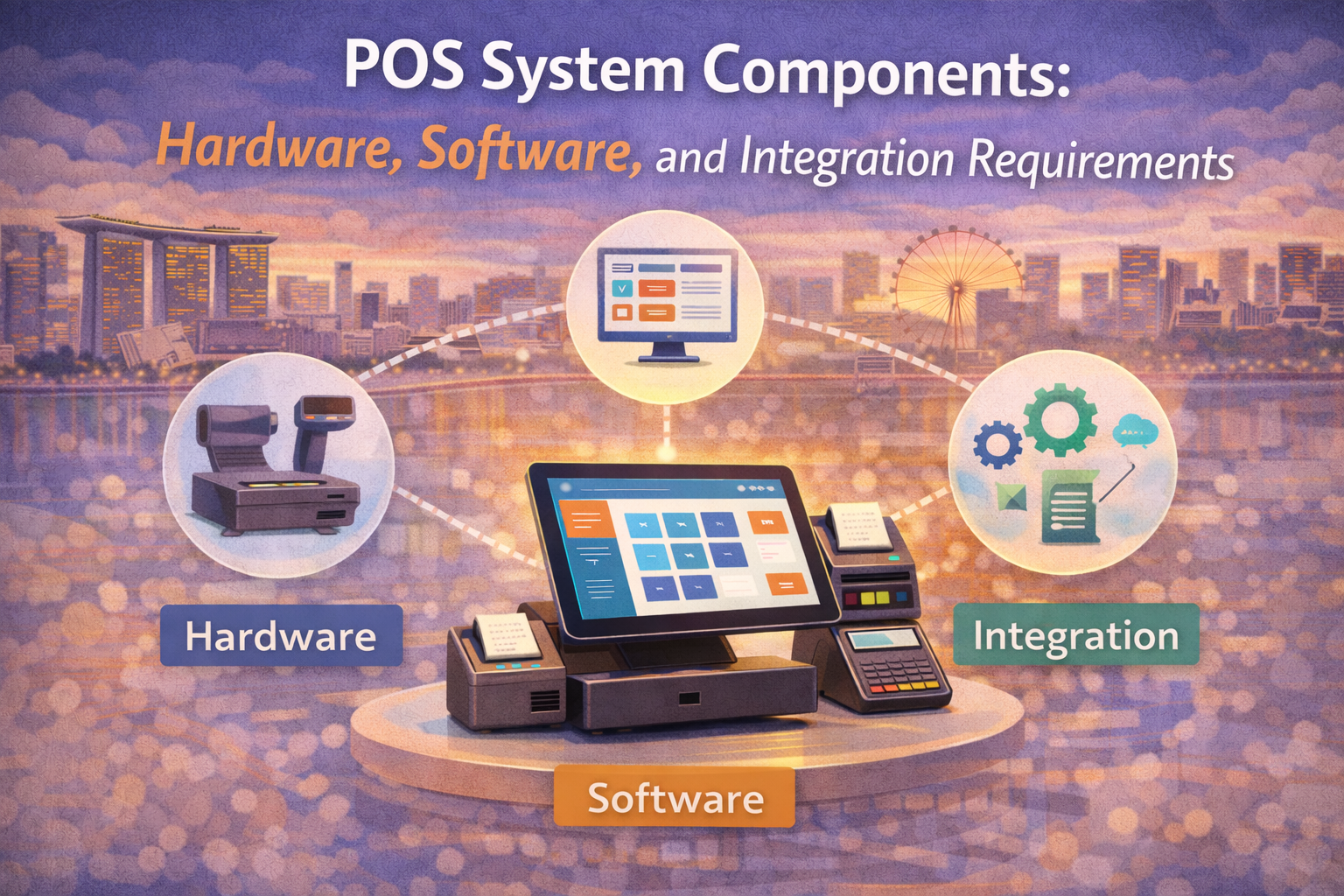
A Point of Sale system represents the location where customers complete purchases and make payments. Modern POS systems combine hardware and software to create a complete business management platform that handles transactions, inventory tracking, customer relationship management, sales reporting, and staff management.
The contemporary POS system has transcended its origins as a digital cash register. Today’s solutions integrate with accounting software, e-commerce platforms, delivery services, and payment gateways to create a unified operational ecosystem. For Singapore businesses, this integration is particularly crucial given the diverse payment methods customers expect, from PayNow and GrabPay to international digital wallets.
Singapore-Specific POS Requirements and Regulations
Operating a business in Singapore requires compliance with several regulatory frameworks that directly impact POS system selection.
GST Compliance and InvoiceNow Requirements
All POS systems must accurately calculate and apply Singapore’s 9% GST rate. From November 2025, newly incorporated companies registering voluntarily for GST must transmit invoice data to IRAS using InvoiceNow-ready solutions via the Peppol network. By April 2026, this requirement extends to all new voluntary GST registrants.[1][2]
Cloud-based POS systems offer significant advantages for GST compliance by automatically generating GST-compliant receipts, calculating tax breakdowns, exporting data in IRAS-compatible formats, and maintaining timestamped transaction logs for audit trails. These features streamline the previously labor-intensive process of GST filing and reduce the risk of compliance errors.
Personal Data Protection Act (PDPA) Compliance
Every organization handling customer data in Singapore must comply with the Personal Data Protection Act. For POS systems, this means implementing proper data security measures, appointing a Data Protection Officer, establishing data breach response procedures, and ensuring customer information is collected, stored, and used appropriately.[3][4][5]
Organizations failing to meet PDPA requirements face fines up to S$1 million or 10% of annual turnover, whichever is higher. When evaluating POS systems, verify that providers offer robust security features including end-to-end encryption, secure data storage, and regular security updates.[6]
Payment Processing Regulations
The Monetary Authority of Singapore (MAS) and the Association of Banks in Singapore are establishing Singapore Payments Network (SPaN) to consolidate administration of national payment schemes. This new entity will set stricter standards affecting POS providers and merchants throughout 2025 and beyond.
Additionally, Electronic Deferred Payment solutions launched in mid-2025 support the transition from corporate cheques to e-payments, with corporate cheque cessation extended to end-2026. POS systems must accommodate these evolving payment standards to remain compliant and functional.
Types of POS Systems Available in Singapore
Understanding the different POS system types helps business owners select solutions matching their operational model.
Cloud-Based POS Systems
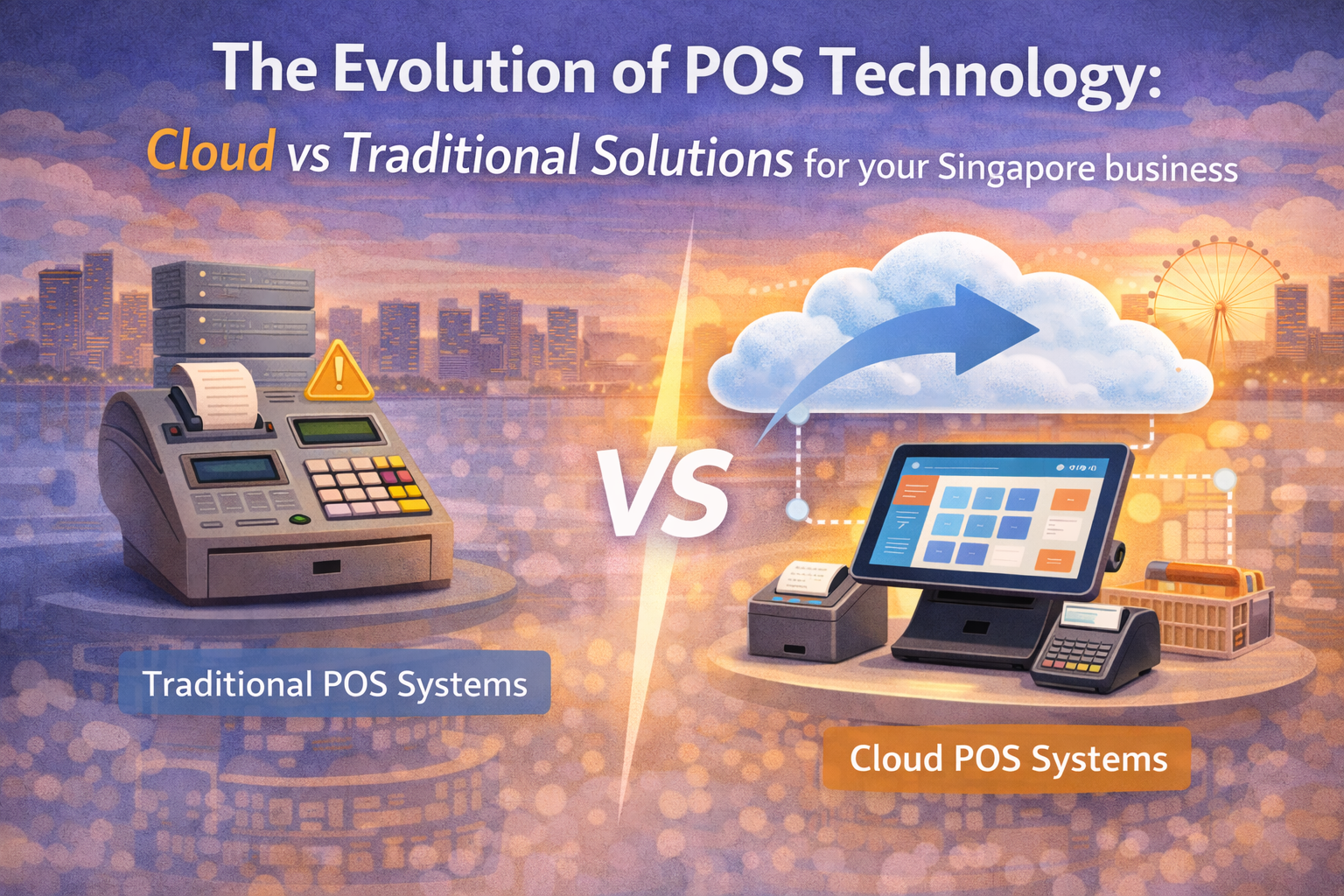
Cloud-based systems store data on remote servers accessible via internet connection from any device. These solutions dominate Singapore’s market due to remote access capabilities, automatic software updates, real-time data synchronization across locations, scalability without hardware investments, and integrated backup and disaster recovery.
Cloud POS systems typically achieve 99.9% uptime reliability compared to 95-97% for traditional systems. For Singapore businesses managing multiple outlets or requiring flexible access, cloud-based solutions offer unparalleled operational advantages. Implementation typically requires just 24-48 hours with minimal disruption.
Modern cloud-based platforms provide automatic data backup and synchronization across all devices, enabling business owners to monitor operations remotely through mobile apps, access real-time reporting from anywhere, and maintain business continuity even during unexpected disruptions. This flexibility proves especially valuable for Singapore’s fast-paced business environment where decisions need to be made quickly based on current data.
Traditional POS Systems
Traditional systems use locally-stored data on dedicated hardware at fixed locations. While less common in Singapore’s modern retail landscape, they offer advantages for businesses with unreliable internet connectivity or those preferring local data control. Traditional systems feature robust hardware designed for high-volume transactions and operate independently of internet availability.
However, traditional POS systems require higher upfront investments, manual software updates, limited remote access, and additional hardware for each location. Annual maintenance costs typically range from S$1,500 to S$4,000, plus emergency service calls.
Mobile POS Systems
Mobile POS operates on smartphones and tablets, enabling staff to process transactions anywhere. This portability proves invaluable for Singapore’s hawker centers, pop-up stores, food trucks, and restaurants offering table-side service.
Mobile POS systems require minimal upfront investment, typically offered through affordable subscription models. They support various payment methods including contactless options, integrate easily with other business tools, and provide real-time inventory and sales data. The flexibility makes mobile POS particularly attractive for startups and SMEs.
Solutions like BigPOS Lite exemplify this category, offering centralized transaction tracking, contactless payment support, employee management tools, and unified e-payment integration—all optimized specifically for kiosks, food trucks, food stalls, and small service businesses in Singapore.
Retail vs F&B Specific Systems
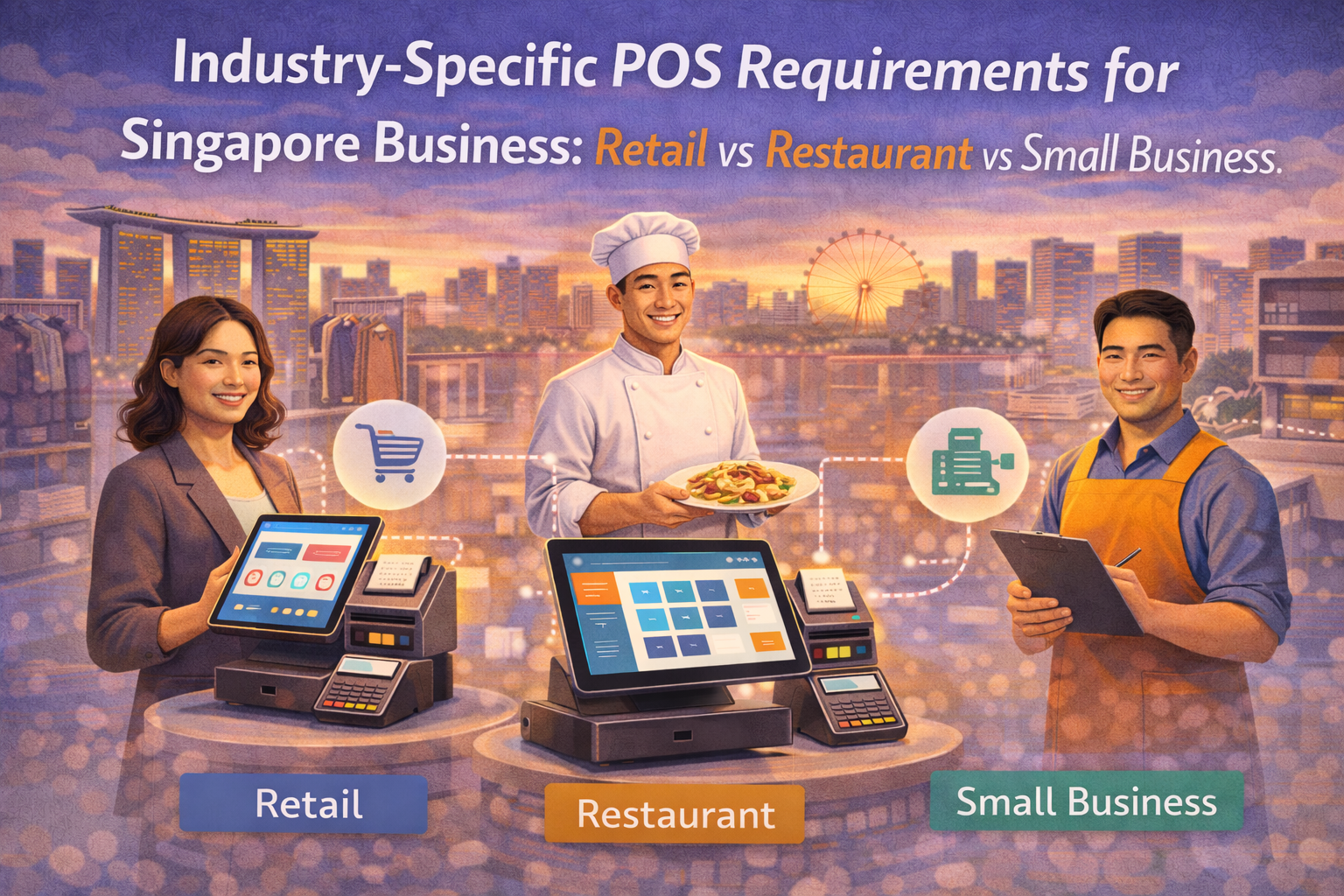
Industry-specific POS systems address unique operational requirements. Retail POS focuses on inventory management with barcode scanning, SKU tracking, stock alerts, multi-location management, and integration with e-commerce platforms.
F&B POS emphasizes table management, menu customization with modifiers, kitchen display system integration, bill splitting capabilities, and reservation platform connections. Modern F&B solutions like BigPOS Pro’s Display System (KDS-CDS) streamline kitchen operations by instantly notifying chefs of new orders, preventing order mistakes, and displaying order status on customer-facing screens. Mobile ordering capabilities through solutions like BIG Waiter eliminate front-end congestion by sending orders directly from tables to the kitchen, replacing traditional pen-and-paper systems while enabling real-time synchronization and staff attendance tracking. Choosing industry-appropriate systems ensures access to features critical for daily operations rather than generic solutions requiring workarounds.
Key Features to Look for in a Singapore POS System
When evaluating POS systems, prioritize features addressing both universal needs and Singapore-specific requirements.
Payment Processing and Integration
Singapore’s cashless payment adoption demands POS systems supporting PayNow, GrabPay, credit and debit cards, QR code payments (SGQR), Buy Now Pay Later services, and international digital wallets. Systems with native integration of local payment methods process transactions faster and more reliably than third-party integrations.
Transaction fees vary significantly between providers. PayNow transactions often feature near-zero percentage rates, making them cost-effective for high-volume businesses.
Beyond payment acceptance, advanced POS systems now offer QR menu ordering capabilities that enable scan-to-order functionality with complete product information and integrated payment processing. This feature reduces staffing requirements during peak hours, minimizes order errors, and provides customers with contactless ordering options increasingly expected in Singapore’s post-pandemic retail environment.
Inventory Management
Real-time inventory tracking prevents stockouts and overstocking, which can reduce holding costs by 10-20%. Essential inventory features include automated low-stock alerts, multi-location stock visibility, purchase order generation, supplier management, and barcode scanning capabilities.
For Singapore’s space-constrained retail environments where storage costs are premium, optimized inventory management directly impacts profitability. Cloud-based systems synchronize inventory across all sales channels, preventing overselling and enabling click-and-collect services.
Advanced solutions like BIG Inventory provide mobile inventory management with precise location tracking for every item, automated stock alerts to prevent shortages, instant real-time inventory reports, and centralized management capabilities for multiple branches from a single platform. This level of accuracy minimizes manual data entry errors through real-time synchronization and scales effortlessly as businesses expand across multiple outlets.
Reporting and Analytics
Data-driven decision making separates thriving businesses from struggling competitors. Modern POS systems generate reports on sales trends by product, time, and location, employee performance metrics, customer purchasing patterns, profit margins by item or category, and peak hours analysis.
AI-powered analytics are emerging as 2025’s defining trend, offering predictive insights, automated reorder suggestions, and marketing recommendations based on customer behavior. Solutions like BIG Analytics enable data-driven management through real-time sales reports and performance tracking accessible remotely. The platform quickly identifies star products to optimize marketing efforts, tracks spending behaviors over time, and provides mobile tracking capabilities through dedicated apps for monitoring sales and inventory anywhere, anytime. Powerful reporting features support 24/7 tracking with daily, weekly, and monthly performance reports, giving Singapore business owners the strategic insights needed to compete effectively despite tight margins and intense competition.
Customer Relationship Management
Built-in CRM features enable businesses to capture customer information, track purchase history, implement loyalty programs, send targeted promotions, and personalize service. Research indicates that increasing customer retention rates by 5% increases profits by 25% to 95%.
Singapore’s competitive retail landscape makes customer loyalty programs essential differentiators. POS-integrated CRM eliminates the need for separate systems and ensures seamless data flow between sales and marketing activities.
Comprehensive loyalty solutions like B-Rewards foster repeat business by allowing customers to collect and redeem points while providing merchants with tools for better relationship management. The platform enables exclusive discounts for VIP customers, centralized promotion management for store-wide campaigns, behavioral rewards based on specific shopping habits, and customer insights through buying history analysis. These capabilities help Singapore businesses build lasting customer relationships and drive sustainable growth.
Multi-Location Management
Businesses operating multiple outlets require centralized control showing real-time sales across all branches, inventory transfers between locations, unified pricing and promotion updates, and performance comparisons. Modern POS systems provide single-dashboard oversight, reducing administrative burden and ensuring consistency across locations.
Enterprise-grade solutions like BigPOS Pro excel in multi-outlet management by centralizing operations and standardization across multiple store locations. The platform supports unlimited product management with no restrictions on items that can be added, QR menu ordering with scan-to-order functionality and integrated payments, comprehensive stock management with frequent software updates, built-in loyalty system integration, and unified e-commerce solutions for seamless multichannel selling across online and offline channels.
According to Enterprise Singapore, businesses investing in digital solutions like advanced POS systems show productivity gains up to 30% and are better positioned for sustainable growth.[7]
How to Choose the Right POS System for Your Business
Selecting the optimal POS system requires systematic evaluation aligned with business needs.
Assess Your Business Requirements
Start by identifying your business type (retail, F&B, or service), sales volume and transaction frequency, number of locations (current and planned), payment methods you need to support, and industry-specific features required. Businesses processing hundreds of transactions daily need systems optimized for speed and reliability, while those with complex inventory require advanced stock management.
Additionally, consider operational needs such as employee management capabilities for tracking staff attendance and simplifying payroll, table management for F&B establishments, and queue management systems to reduce front-end congestion during peak hours. The right feature set eliminates the need for multiple disconnected systems and streamlines daily operations.
Evaluate Scalability
Your POS system should grow with your business. Cloud-based solutions scale effortlessly by adding new locations without hardware installations, increasing user licenses on-demand, expanding menu items and inventory categories, and integrating additional payment methods. Choosing scalable systems avoids costly replacements as operations expand.
Consider starting with entry-level solutions for initial operations, then upgrading to enterprise features as you grow. For example, businesses can begin with lightweight systems for single locations and transition to comprehensive platforms supporting unlimited products, multi-outlet management, and advanced integrations as expansion occurs.
Consider Integration Capabilities
Seamless integration with existing tools prevents data silos and manual work. Verify POS compatibility with your accounting software, e-commerce platforms (Lazada, Shopee), and delivery services (GrabFood, Foodpanda, Deliveroo).
Integration failures create operational bottlenecks and data discrepancies. Always confirm integration capabilities before committing to a POS provider. Look for solutions offering unified platforms that connect online and offline sales channels, automated data synchronization, and comprehensive API support for third-party integrations.
Compare Pricing Models
POS systems employ various pricing structures. Subscription-based models charge monthly or annual fees ranging from S$39 to S$99 per month for most SME solutions. Some providers offer hardware rental with competitive merchant discount rates for card payments.
Calculate total cost of ownership including software subscription fees, hardware purchases or rentals, payment processing fees, maintenance and support costs, and training expenses. The cheapest option rarely provides the best value—focus on features, support, reliability, and long-term ROI.
Verify Local Support and Compliance
Choose providers with established Singapore operations offering local customer support, understanding of regulatory requirements, timely system updates for compliance changes, and experience with Singapore business environments. Local support proves invaluable when troubleshooting issues during peak business hours or navigating regulatory changes.
Test Before Committing
Most reputable POS providers offer free trials or demonstrations. Use this opportunity to test ease of use for your staff, transaction processing speed, reliability during peak simulation, report quality and accessibility, and integration with your existing systems. Hands-on testing reveals usability issues that specifications don’t capture.
Productivity Solutions Grant (PSG) for POS Systems
Singapore SMEs can access government funding to offset POS system costs through the Productivity Solutions Grant.[8][9]
PSG Coverage and Benefits
The PSG covers up to 50% of costs for pre-approved POS systems, significantly reducing upfront investment. Eligible expenses include POS software and hardware (terminals, printers, cash drawers), inventory management features, integrated payment processing, CRM and loyalty program tools, reporting and analytics capabilities, and integration with other PSG-supported tools like Kitchen Display Systems.
For businesses meeting eligibility criteria, PSG funding makes enterprise-grade POS systems accessible at SME budgets. The program aims to accelerate digital transformation among local businesses, improving productivity and competitiveness.
Eligibility Requirements
To qualify for PSG, businesses must be registered and operating in Singapore, have minimum 30% local shareholding by Singaporeans or Permanent Residents, and use the solution locally. Both new implementations and significant upgrades to existing systems qualify, provided they involve PSG-approved solutions.
Application Process
Applying for PSG follows a straightforward process. First, verify your business meets eligibility criteria. Second, select a pre-approved POS vendor from IMDA’s list. Third, request formal quotations from chosen vendors. Fourth, submit applications via the Business Grants Portal with supporting documents. Fifth, await approval (typically 4-6 weeks). Finally, implement the system and submit claims for reimbursement.
Critical note: purchases made before approval will not be reimbursed. Always secure approval before signing contracts or making payments.
Common Mistakes to Avoid When Choosing a POS System
Understanding common pitfalls helps business owners make better decisions.
Choosing Generic Over Industry-Specific Solutions
The most frequent mistake involves selecting generic POS systems that don’t address industry-specific needs. Restaurants require table management and kitchen integrations while retailers need advanced inventory tracking and barcode scanning. Generic systems force operational workarounds that reduce efficiency and staff satisfaction.
Ignoring Cloud-Based Options
Some business owners hesitate to adopt cloud solutions due to misconceptions about security or control. However, cloud-based systems offer superior data protection through automated backups, disaster recovery capabilities, and professional-grade security that most individual businesses cannot match. The flexibility and scalability of cloud POS outweigh perceived advantages of local data storage for most Singapore businesses.
Focusing Solely on Price
Choosing the cheapest POS system often leads to hidden costs and operational inefficiencies. Inadequate support, limited features, poor integration, and frequent downtime can cost far more than the initial savings. Evaluate total value including features, reliability, support quality, and scalability when comparing options.
Neglecting Staff Training
Even the best POS system fails without proper staff training. Inadequate training leads to operational errors, decreased productivity, slower transactions, and customer dissatisfaction. Implement comprehensive training programs ensuring all staff members are proficient with essential functions before go-live.
Underestimating Hardware Importance
While software features attract attention, hardware quality significantly impacts daily operations. Cheap terminals, slow processors, and unreliable peripherals cause transaction delays and system failures. Invest in durable, compatible hardware with adequate processing power and warranties appropriate for your business environment.
Future Trends in Singapore POS Systems
Understanding emerging trends helps future-proof your investment.
AI-Powered Analytics and Predictions
Artificial intelligence is revolutionizing POS capabilities, offering predictive sales forecasts, automated inventory optimization, personalized customer recommendations, and dynamic pricing suggestions. These features help Singapore SMEs compete with larger competitors through data-driven decision making previously accessible only to enterprises.
Enhanced Omnichannel Integration
Omnichannel retail—seamlessly connecting online and offline channels—is becoming standard rather than optional. Modern POS systems synchronize inventory across all channels, enable buy-online-pickup-in-store, process returns regardless of purchase channel, and maintain unified customer profiles. With Singapore consumers expecting consistent experiences across touchpoints, omnichannel capabilities are competitive necessities.
Advanced platforms now offer unified e-commerce solutions that integrate physical stores with online marketplaces, social commerce channels, and proprietary web stores. This integration ensures inventory accuracy across all sales channels, prevents overselling, provides customers with real-time stock visibility, and creates seamless shopping experiences whether customers browse online or in-store.
Contactless and Biometric Payments
While contactless payments dominate Singapore today, biometric authentication using fingerprint and facial recognition is emerging. Voice-activated payment processing and IoT device integration for inventory management represent additional frontiers. POS systems supporting these innovations position businesses for seamless adoption as technologies mature.
Sustainability Features
Singapore’s Green Plan 2030 drives demand for sustainable business practices. Modern POS systems support environmental goals through paperless e-receipts, cloud-based reports replacing printed documents, and energy-efficient hardware. These features help businesses reduce environmental impact while enhancing operational efficiency and brand reputation among environmentally conscious consumers.
Frequently Asked Questions
How much does a POS system cost in Singapore?
POS system costs vary based on features, business size, and pricing model. Basic subscription plans start around S$39-99 per month. Hardware costs range from S$0 (for mobile POS using existing devices) to S$2,000 for complete traditional systems. Payment processing fees typically range from 0.7% to 2.7% per transaction. PSG grants can cover up to 50% of costs for eligible businesses.
Do I need internet connection for my POS system?
Cloud-based POS systems require internet connectivity for full functionality, though many offer offline modes that sync data when connection resumes. Traditional POS systems operate independently of internet but lack remote access and real-time synchronization capabilities. For Singapore businesses with reliable connectivity, cloud-based systems offer superior advantages despite internet dependency.
Can my POS system integrate with my existing accounting software?
Most modern POS systems integrate with popular accounting platforms used in Singapore. Verify integration capabilities with your specific accounting software before purchase. Proper integration eliminates manual data entry, reduces errors, and streamlines financial reporting and tax compliance. Look for POS solutions offering automated data export in standard formats compatible with Singapore accounting standards and IRAS requirements.
What payment methods should my Singapore POS system support?
Essential payment methods for Singapore businesses include PayNow, GrabPay, credit and debit cards, SGQR code payments, NETS, international digital wallets (Apple Pay, Samsung Pay, Alipay), and Buy Now Pay Later services. Comprehensive payment support ensures you never lose sales due to payment method limitations.
How long does POS system implementation take?
Cloud-based POS systems typically require 24-48 hours for implementation with minimal operational disruption. Traditional systems may require several days to weeks depending on complexity, hardware installation, and staff training requirements. Factor in additional time for staff training and system familiarization regardless of POS type.
Conclusion
Singapore’s dynamic business environment demands POS systems that transcend basic transaction processing. The right solution streamlines operations, ensures regulatory compliance, provides actionable insights, enhances customer experiences, and scales with business growth.
Whether you operate a single retail outlet, manage multiple F&B locations, or run an omnichannel business, investing time in proper POS system selection pays dividends through improved efficiency, reduced costs, and competitive advantages. With 97% cashless adoption and evolving regulatory requirements including InvoiceNow mandates and SPaN implementation, choosing a modern, compliant POS system is not optional—it’s essential for business survival and success.
Modern POS ecosystems offer comprehensive modules covering everything from mobile inventory management and kitchen display systems to loyalty programs and real-time analytics dashboards. The best systems provide scalable architectures that allow businesses to start with essential features and expand capabilities as operations grow—from lightweight solutions for food stalls and kiosks to enterprise platforms supporting unlimited products, multi-location operations, and integrated e-commerce channels.
Take advantage of PSG grants to reduce costs, prioritize cloud-based solutions for flexibility and scalability, ensure comprehensive local payment method support, verify PDPA and GST compliance capabilities, and select providers with strong Singapore presence and support. By following this guide’s principles and avoiding common mistakes, Singapore business owners can confidently select POS systems that drive operational excellence and sustainable growth in 2025 and beyond.
- https://www.iras.gov.sg/taxes/goods-services-tax-(gst)/gst-invoicenow-requirement
- https://anusaar.com/blogs/gst-invoicenow-understanding-the-requirement-in-singapore/
- https://www.hawksford.com/insights-and-guides/data-protection-in-singapore
- https://dataprivacymanager.net/pdpa-compliance-checklist-for-singapore-businesses/
- https://www.vistra.com/insights/personal-data-protection-legislation-requirements-singapore
- https://services2.imda.gov.sg/ctoaas/highlight/93/simplify-sales-with-a-point-of-sale-system–sme-digital-solutions–
- https://www.enterprisesg.gov.sg/financial-support/productivity-solutions-grant
- https://www.enterprisesg.gov.sg/financial-support/productivity-solutions-grant
- https://www.businessgrants.gov.sg