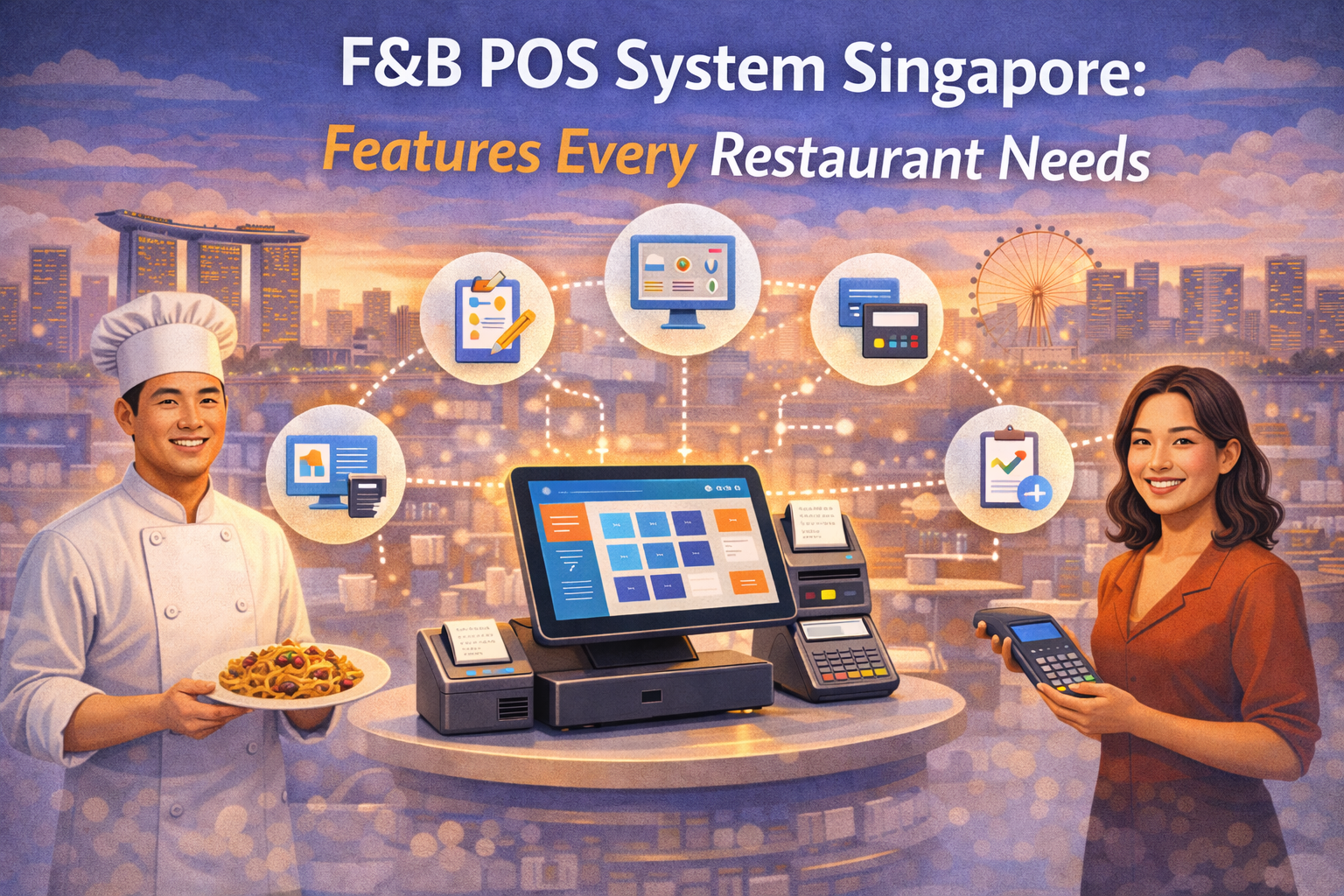
F&B POS System Singapore: Features Every Restaurant Needs
Introduction
Singapore’s competitive food and beverage industry demands operational excellence at every level. Whether you’re running a hawker stall, a casual café, or a full-service restaurant, a modern F&B POS (Point of Sale) system has become essential rather than optional. With rising labor costs, complex regulatory requirements, and evolving customer expectations, restaurant owners cannot afford to rely on outdated cash registers or manual order-taking processes.
The right POS system for restaurants in Singapore does far more than process payments—it streamlines kitchen operations, manages inventory in real-time, ensures regulatory compliance with Singapore’s GST requirements, integrates with food delivery platforms like GrabFood and Foodpanda, and provides critical insights into business performance.
This comprehensive guide explores the essential features that every F&B business in Singapore should prioritize when selecting a POS system, backed by practical applications and compliance considerations specific to the local market. We’ll also introduce BigPOS—a complete POS solution designed specifically for Singapore’s F&B industry, offering scalable systems from small hawker stalls to multi-outlet restaurant chains.
Why F&B Businesses in Singapore Need Modern POS Systems
The Operational Challenge
Singapore’s F&B sector faces unique operational pressures.[12] According to industry data, restaurants struggle with rising costs, manpower shortages, food waste management, and the pressure to optimize table turnover during peak hours. Manual order-taking processes lead to errors that cascade through the system—incorrect orders reach the kitchen, customers wait longer, and staff productivity plummets.
Without proper inventory tracking, many Singapore restaurants experience 15-20% food waste, translating directly to lost profitability. The regulatory environment compounds these challenges: F&B businesses with annual revenue exceeding S$1 million must register for Goods and Services Tax (GST), currently at 9%, and maintain meticulous records for quarterly GST filing requirements.[3][5]
The Financial Impact
A well-implemented F&B POS system can deliver measurable returns within the first year. Research shows that restaurants adopting modern cloud-based POS systems report 10-15% faster table turnover and 5-8% lower inventory waste within the first quarter.[9] When multiplied across multiple outlets or applied to high-volume establishments, these improvements translate into significant revenue gains and cost savings.
The Singapore government recognizes the importance of digital transformation for SMEs. The Productivity Solutions Grant (PSG) covers up to 50% of POS system costs for qualifying businesses, reducing the financial barrier to adoption and making modern POS technology accessible even for small restaurants and hawker stalls.[14]
Core POS System Features Every Restaurant Needs
1. Order Management and Kitchen Integration
Efficient order management separates successful restaurants from those struggling with bottlenecks. A robust F&B POS system should consolidate orders from all channels—dine-in, takeaway, delivery platforms, and online ordering—into a single unified system.
Kitchen Display System (KDS) integration is non-negotiable. Rather than relying on printed order tickets that can get lost or misread, a digital KDS displays orders on screens in the kitchen, color-coded by priority, course, or preparation station. Orders appear in real-time the moment customers place them, eliminating the communication delay that leads to order errors and customer frustration.
Modern KDS systems include features like:
- Real-time order status tracking with cooking time management
- Color-coded alerts for different order priorities (dine-in vs. takeaway vs. delivery)
- Strike-through functionality to mark completed items and prevent duplicate work
- Special instruction clarity that reduces misunderstandings between front-of-house and kitchen staff
- Integration with kitchen printers for backup and precise item routing to specific stations
For F&B establishments with multiple kitchen stations—separate areas for hot food, cold items, beverages, or desserts—advanced KDS systems allow order routing to specific screens, ensuring each station receives only the items they need to prepare.
2. Multi-Channel Integration and Delivery Platform Connectivity
Singapore’s F&B landscape increasingly relies on delivery platforms. GrabFood, Foodpanda, Deliveroo, and Shopee Food dominate online ordering, but many restaurants struggle managing orders across multiple channels simultaneously. A modern F&B POS system eliminates this friction through seamless integration.
When orders from delivery platforms integrate directly with your POS system, several benefits emerge immediately:
- Automatic order consolidation: Orders placed on GrabFood appear automatically in your POS without manual re-entry, reducing errors and accelerating kitchen processing
- Unified inventory management: The system automatically deducts delivered items from inventory, providing accurate stock levels across all sales channels
- Consolidated reporting: Sales from dine-in, takeaway, and delivery channels consolidate into unified reports, providing clear visibility into revenue drivers
- Centralized menu management: Update your menu once in the POS system, and changes propagate to all connected platforms within minutes
For restaurants with multiple outlets, this integration becomes critical. A single dashboard allows managers to oversee order flow, inventory levels, and performance metrics across all locations simultaneously.
3. QR Code Ordering and Contactless Service
Post-pandemic dining habits have shifted permanently. Many customers now prefer contactless QR code ordering, which also provides restaurants with operational advantages. Rather than waiting for staff to take orders manually, customers scan a QR code at their table, browse the menu on their device, place their order, and pay—all without staff interaction.
Benefits of integrated QR ordering systems include:
- Reduced order-taking time: Staff spends less time taking orders and more time delivering exceptional service and managing the dining room
- Higher order accuracy: Customers select items themselves, eliminating miscommunication that leads to remakes and waste
- Improved table turnover: Faster ordering and payment processes mean more customers served during peak hours
- Upselling opportunities: Digital menus can highlight specials, recommend complementary items, and display high-margin dishes more prominently
- Customer data collection: The system can capture customer preferences and contact information for targeted marketing and loyalty programs
For F&B businesses operating in high-volume environments—food courts, hawker stalls, or quick-service restaurants—QR ordering reduces staff dependency while maintaining service quality.
4. Real-Time Inventory Management
Food waste represents a significant profit leak for Singapore’s F&B businesses.[2][4] Inefficient inventory management creates the perfect storm: ingredients spoil due to overstocking, staff cannot locate items causing over-purchasing, and production waste from inaccurate par levels accumulates.
A comprehensive POS inventory system should provide:[6]
- Real-time stock tracking: Monitor ingredient levels throughout the day, with automatic updates as items are used in meal preparation
- Recipe-based inventory management: Link recipes to inventory, so the system automatically deducts ingredients when dishes are ordered
- FIFO (First-In-First-Out) tracking: Tag items with purchase dates and automatically alert staff when older items need use first, critical for perishable ingredients
- Low-stock alerts: Receive notifications when inventory falls below predefined thresholds, triggering timely reordering before stockouts occur
- Variance reporting: Track the gap between expected inventory usage (based on recipes and sales) and actual usage, highlighting discrepancies that may indicate waste, theft, or portion control issues
- Supplier integration: Many advanced systems can generate purchase orders automatically and track incoming deliveries against orders
For restaurants maintaining ingredient inventory at the item level—tracking dairy, meats, fresh vegetables, and pantry staples—this granular visibility directly impacts food costs. Singapore restaurants leveraging sophisticated inventory management report 5-8% reductions in waste within the first quarter of implementation.
5. Cloud-Based Access and Multi-Outlet Management
Singapore’s restaurant landscape increasingly features multi-outlet operations. Chain restaurants, franchise models, and owner-operators expanding to new locations all face the challenge of maintaining consistent operations across multiple points of sale.
Cloud-based POS systems provide unparalleled flexibility:
- Centralized dashboard: Access real-time sales, inventory, and performance data for all outlets from a single interface
- Standardized operations: Push menu updates, promotions, pricing changes, and operational procedures to all outlets simultaneously
- Real-time reporting: Compare performance across locations, identify top-performing outlets, and make data-driven expansion decisions
- Flexible scaling: Add new outlets by provisioning subscriptions and syncing data in minutes—traditional systems require hardware duplication and complex data migration taking weeks
- Remote access: Manage operations from anywhere with internet connectivity, allowing owners to make critical decisions even when away from the restaurant
During Singapore’s GST increase from 7% to 9% in 2024, restaurants using cloud POS systems updated pricing across all outlets centrally and deployed changes within minutes.[7] Traditional systems required manual updates at each location, taking 8-12 hours per cycle and risking pricing inconsistencies.
6. Payment Processing and Local Payment Method Support
Singapore customers demand diverse payment options. A modern F&B POS system must support multiple payment methods seamlessly to avoid bottlenecks at checkout.
Essential payment capabilities include:
- Credit and debit cards: Full support for Visa, Mastercard, and American Express
- Mobile payment methods: Apple Pay, Google Pay, and contactless NFC payments
- E-wallets: Popular Singapore payment methods including Grab Pay, GCash, and other digital wallets
- QR code payments: PayNow QR codes and other QR-based payment systems that have become ubiquitous in Singapore
- Split billing: Divide checks among multiple customers or payment methods, essential for group dining
- Partial payments: Accept payment installments, allowing customers to pay multiple times if needed
- Cash transactions: Despite digital payment growth, many Singapore customers still prefer cash, requiring reliable cash handling and drawer management
Payment processing through the POS system should include integrated payment terminals that work seamlessly with the ordering system, eliminating the need for separate payment devices and reducing transaction time at checkout.
7. Table Management and Reservation System
For full-service restaurants and fine-dining establishments, efficient table management directly impacts profitability.[10] A POS system with integrated table management features optimizes table turnover and customer experience.
Key features include:
- Visual table layout: Display floor layout on POS terminals, showing which tables are occupied, empty, reserved, or waiting to be cleaned
- Table status tracking: Instantly see which tables are ready to order, waiting for food, or ready for payment
- Hold and fire functionality: Place orders on hold when customers aren’t ready to order, then release (fire) them to the kitchen simultaneously
- Table timer: Automatically track how long customers have occupied each table, helping identify tables ready for clearing during peak hours
- Merge and split tables: Combine multiple tables for group dining or split a single table among multiple checks
- Reservation integration: Sync online reservations with table availability, preventing double-booking and optimizing table allocation
For restaurants struggling with table turnover during lunch and dinner service, these features can drive 10-15% improvements in covers served per shift.
8. Loyalty Programs and Customer Relationship Management (CRM)
Customer retention costs substantially less than acquisition. A POS system integrated with CRM capabilities helps restaurants build lasting customer relationships and drive repeat business.
Loyalty program features include:
- Automatic points earning: Customers earn rewards automatically on purchases without manual entry
- Tiered membership: Create loyalty tiers offering escalating benefits as customers reach spend thresholds
- Personalized promotions: Target specific customer segments with tailored offers based on purchase history
- Birthday and anniversary rewards: Automatically trigger special offers during important customer milestones
- Redemption management: Allow customers to redeem points for meals, discounts, or exclusive experiences through a single system
- Customer data collection: Capture customer contact information and preferences, enabling targeted email marketing and personalized service
For restaurants competing in Singapore’s saturated food market, loyalty programs integrated with POS systems have proven to increase customer lifetime value by 20-30%, making the investment in CRM-enabled POS systems highly justified.
9. Staff Management and Scheduling
Labor represents 25-35% of F&B operating costs in Singapore.[8]
Optimizing staff productivity and scheduling through the POS system directly improves profitability.
Staff management features should include:
- Employee login and tracking: Each staff member logs in when starting their shift, with the system tracking who processed each transaction and prepared each order
- Performance metrics: Access detailed reports on individual staff performance—transactions processed, average transaction value, discounts given, and payment methods used
- Scheduling integration: Many POS systems integrate with dedicated scheduling software or include built-in scheduling features that optimize staffing based on predicted demand
- Clock-in/out functionality: Streamline payroll by automatically logging staff work hours directly in the POS system
- User permissions and roles: Set granular permissions limiting what individual staff members can do—for example, restricting discount authority or payment method changes to managers only
By linking POS data to scheduling algorithms that predict busy periods based on historical data, restaurants can right-size staffing levels and reduce unnecessary labor costs.
10. Comprehensive Reporting and Analytics
Data-driven decision-making separates thriving restaurants from struggling ones. A modern F&B POS system should provide extensive reporting capabilities that translate raw transaction data into actionable business insights.
Critical reports include:
- Sales by menu item: Identify top-selling dishes and underperformers, enabling menu optimization and strategic pricing
- Peak hour analysis: Understand customer traffic patterns and staffing needs throughout the day
- Staff performance reports: Track individual employee sales, productivity, and compliance with company procedures
- Inventory reports: Monitor stock levels, usage rates, and identify items with high variance between expected and actual usage
- Customer reports: Analyze customer demographics, purchase frequency, average order value, and lifetime value
- Payment method analysis: Understand customer payment preferences and optimize payment terminal placement accordingly
- Period comparisons: Compare current performance to previous days, weeks, or years to identify trends
For GST compliance, modern POS systems automatically generate GST-compliant reports that export directly to IRAS-compatible formats, reducing the accounting workload and minimizing compliance risk.[1][3]
Compliance and Regulatory Considerations for Singapore F&B Businesses
GST Compliance and Price Display Requirements
F&B businesses in Singapore with annual taxable turnover exceeding S$1 million must register for GST.[3] Currently at 9% (effective from 2024), GST compliance is non-negotiable, and price display errors can result in fines from IRAS (Inland Revenue Authority of Singapore).[5][7]
A compliant F&B POS system should:
- Auto-calculate GST: Automatically apply the correct 9% GST rate to applicable transactions
- Display GST-inclusive prices: Generate receipts and price displays showing final GST-inclusive amounts to customers
- Provide GST reporting: Automatically compile sales data by tax status, generating GST returns ready for quarterly filing
- Support GST-exempt items: Correctly handle exempt items like uncooked food ingredients or meals for certain demographics
- Maintain audit trails: Keep timestamped records of all transactions for IRAS audits
Special considerations apply to F&B businesses that impose a service charge. IRAS allows these establishments to display prices before GST only if a genuine service charge applies, but single-service-charge displays without legitimate business reasons trigger compliance violations.[5]
Food Safety and Ingredient Traceability
Singapore’s food safety regulations increasingly emphasize ingredient traceability. The National Environment Agency (NEA) requires F&B businesses to maintain food records and documentation, particularly for high-risk items.
POS systems supporting food safety compliance include:
- Batch tracking: Log ingredient batches upon receipt and track which meals used specific batches, enabling rapid recall if safety issues emerge
- Expiration date monitoring: Automatically flag items approaching expiration and prevent their use beyond safe dates
- Supplier documentation: Maintain digital records of supplier certificates and food handling documentation
- Food preparation logs: Create audit trails documenting food preparation, storage conditions, and safety procedures
Food Waste Management and Sustainability Reporting
Singapore’s sustainability agenda increasingly impacts F&B businesses.[11]The NEA mandates that large commercial establishments segregate food waste for treatment, and new buildings must incorporate on-site food waste treatment systems starting March 2024.
Modern POS inventory systems support sustainability goals by:
- Tracking waste by item: Identify which menu items generate the most waste, enabling menu engineering or preparation procedure adjustments
- Portion analysis: Monitor portion consistency and identify over-portioning that contributes to waste
- Ingredient usage optimization: Highlight ingredients with high variance between expected and actual usage
- Sustainability reporting: Generate waste reduction metrics for internal tracking and potential sustainability certifications
Employee Management and Compliance
Singapore’s employment regulations require meticulous record-keeping regarding staff hours, overtime, and leave entitlements. POS systems with employee management features help ensure compliance:
- Accurate time tracking: Digital clock-in/out systems create tamper-proof records of staff work hours
- Overtime management: Track excessive hours and alert managers to potential overtime issues
- Leave tracking: Integrate leave entitlements and automatically track annual, medical, and other leave balances
- Audit trails: Maintain detailed records of all payroll-related data for MOM (Ministry of Manpower) compliance
Cloud-Based vs. On-Premise POS Systems: Making the Right Choice for Singapore F&B
Cloud-Based POS Systems: Advantages and Considerations
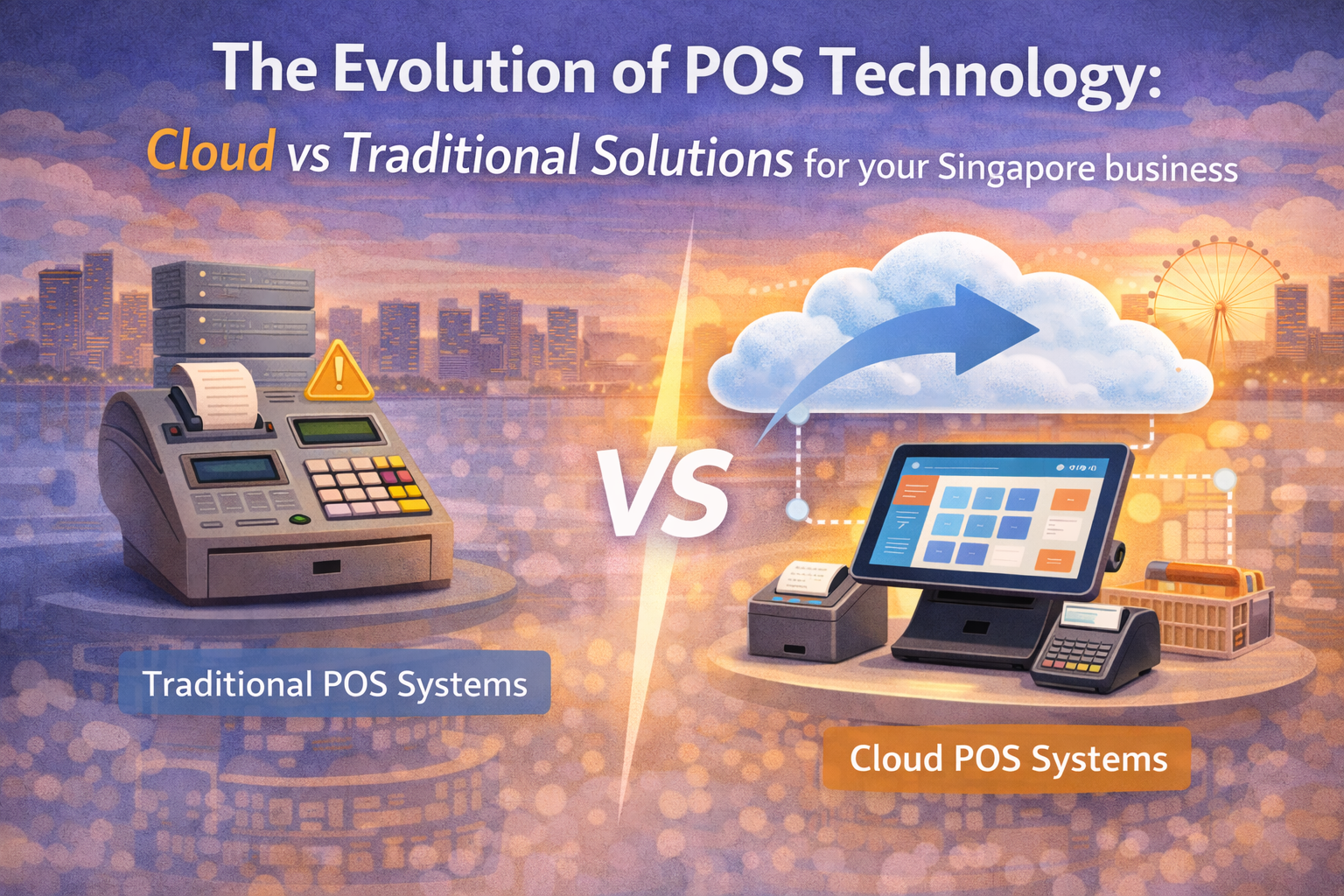
Cloud-based POS systems—where software runs on remote servers accessed through internet-connected devices—dominate Singapore’s modern F&B landscape. The benefits are compelling:
Advantages:
- Lower upfront costs: Reduced hardware investment, from S$2,600-7,500 for traditional systems to S$400-1,000 or less with government grants
- Automatic updates: Receive new features and security patches automatically without service disruptions
- Enterprise-grade security: Modern cloud POS systems use 256-bit encryption (the same standard as financial institutions) and maintain geographically dispersed data backups
- Scalability: Add new outlets or expand capacity by provisioning subscriptions rather than duplicating expensive hardware
- Remote access: Manage operations from anywhere, enabling decision-making even when away from the restaurant
- Rapid regulatory adaptation: Update pricing and compliance procedures quickly when regulations change (like GST rate increases)
- Integration flexibility: Connect seamlessly with delivery platforms, accounting software, and other business systems
The Cyber Security Agency of Singapore confirms that well-implemented cloud solutions offer protection levels that dramatically surpass traditional on-premise systems, addressing the primary concern many restaurant owners have about data security.
Offline Mode Capability: While cloud connectivity is normally required, quality cloud-based systems include offline mode functionality. When internet connectivity drops, the POS continues operating locally, caching all transactions. Once connectivity restores, the system automatically synchronizes data with cloud servers without manual intervention. This ensures business continuity even during Singapore’s occasional network disruptions.
On-Premise POS Systems: Scenarios Where They Make Sense
On-premise systems—where hardware and software run locally without cloud connectivity—have become less common but still serve specific use cases:
When on-premise systems make sense:
- Extremely limited connectivity areas: Some hawker stalls in older buildings with poor internet reliability might benefit
- Specialized regulatory requirements: Certain high-security environments might prefer local data storage
- Legacy system replacement: Existing businesses with significant infrastructure investments might transition gradually
However, for most Singapore F&B businesses, cloud-based systems offer superior advantages and lower total cost of ownership.
ROI and Cost Considerations
Singapore’s government PSG grant makes modern POS adoption financially attractive:
- Hardware costs: Traditional POS terminals: S$2,600-7,500 per outlet; Cloud-based systems: S$400-1,000 per outlet
- PSG subsidy: Up to 50% of system costs covered by government, effectively halving implementation expenses[14]
- Monthly subscription: Typically S$39-150 per month depending on features and outlet count
- Typical ROI: Restaurants report positive ROI within 6-12 months through improved efficiency and waste reduction[13]
When accounting for PSG subsidies, a restaurant implementing a cloud-based POS system might have initial costs of S$300-500 per outlet and ongoing monthly costs of S$60-80—an investment that pays for itself through table turnover improvements and inventory waste reduction alone.
Delivery Platform Integration: Critical for Singapore F&B
GrabFood, Foodpanda, Deliveroo, and Shopee Food dominate Singapore’s online food ordering landscape. Modern restaurants cannot ignore these channels—they represent 15-25% of revenue for many establishments. Integrated POS systems that connect directly with delivery platforms provide substantial operational benefits.
How Delivery Platform Integration Works
Rather than juggling multiple ordering devices, a properly integrated POS system receives delivery platform orders directly:
- Unified order display: Orders from GrabFood, Foodpanda, and dine-in/takeaway channels all appear in one place
- Automatic KDS routing: Orders route to kitchen display systems automatically with delivery orders clearly marked
- Real-time inventory management: Inventory automatically reflects delivery orders, preventing selling items you don’t have
- Consolidated sales reporting: Single dashboard shows revenue from all channels, with detailed breakdowns by platform
- Menu synchronization: Update your menu once in the POS, and changes propagate to all connected delivery platforms within minutes
Without this integration, staff must manually transfer order information from delivery platform apps to the POS, creating opportunities for errors and delays.
Benefits of Delivery Platform Integration
For Singapore restaurants, delivery platform integration offers:
- Operational efficiency: Eliminate manual order entry and the errors that accompany it
- Reduced delivery time: Faster order processing means faster delivery, leading to higher customer satisfaction and better Grab/Foodpanda ratings
- Accurate inventory: Prevent overselling menu items when they’re unavailable
- Peak hour management: Handle multiple simultaneous orders from dine-in, takeaway, and delivery channels without overwhelming kitchen staff
- Competitive advantage: Restaurants with integrated systems can handle higher delivery volume, accepting more orders without service quality degradation
BigPOS: Complete POS Solutions for Singapore F&B Businesses
BigPOS delivers comprehensive point-of-sale solutions specifically designed for Singapore’s F&B industry, addressing every operational challenge discussed in this guide. From small hawker stalls to multi-outlet restaurant chains, BigPOS provides scalable, cloud-based technology that drives operational excellence and profitability.
BigPOS Product Suite: Tailored Solutions for Every Business Stage
BIG POS Lite: Essential Tools for Small Businesses
Perfect for start-ups, kiosks, food trucks, and hawker stalls, BIG POS Lite provides essential POS functionality without overwhelming complexity:
- Optimized for SMEs: Specifically designed for kiosks, food trucks, food stalls, and small service businesses operating in Singapore’s competitive landscape
- Centralized business hub: Track transactions, generate reports, and manage all business tools from one unified platform
- Contactless payment integration: Supports simple and secure payment gateway integrations including PayNow, credit cards, and e-wallets
- Employee management tools: Track staff performance and attendance with free software updates included
- Unified e-payment processing: Integrated payment gateways simplify auditing across different sales income sources
- Customer insights: Capture basic buying history and customer information to understand your market
Ideal for: Hawker stalls, food trucks, single-outlet cafés, kiosks, and start-up F&B businesses requiring reliable, straightforward POS functionality.
BIG POS Pro: Advanced Features for Growing Businesses
Established restaurants and expanding F&B businesses require sophisticated capabilities. BIG POS Pro delivers:
- Multi-outlet management: Centralize operations and standardize procedures across multiple store locations from a single dashboard
- Unlimited product management: No restrictions on the number of products, menu items, or variations you can add and sell
- QR menu ordering: Enable scan-to-order functionality with complete product information and integrated payment processing
- Advanced inventory management: Comprehensive stock control with real-time tracking, low-stock alerts, and variance reporting
- Integrated loyalty system: Built-in B-Rewards program captures consumer data, shopping habits, and enables targeted promotions
- E-commerce integration: Unified platform for multichannel selling across online and offline channels, eliminating data silos
Ideal for: Multi-outlet restaurants, chain operations, fine-dining establishments, and F&B businesses planning aggressive expansion.
BigPOS Add-On Modules: Enhance Your Core System
Display System (KDS-CDS): Kitchen Display & Customer Display Integration
Transform kitchen operations with BigPOS’s integrated Kitchen Display System (KDS) and Customer Display System (CDS):
Kitchen Display Features:
- Highly organized workflow: Structures kitchen operations for efficient meal preparation and service coordination
- Eliminate order mistakes: Instantly notifies chefs of new orders and helps servers manage order flow to prevent missing items
- Seamless POS connectivity: Directly connects to your main BigPOS system for real-time order transmission
- Efficient status management: Drag-and-drop interface updates order statuses instantly
- Multi-station routing: Send orders to specific kitchen stations (hot food, cold prep, beverages, desserts) automatically
Customer Display Features:
- Sophisticated communication: Keep customers informed by displaying their order status on external screens
- Automatic synchronization: Real-time updates sync order progress from KDS to customer-facing displays
- Transparency and trust: Reduce customer anxiety by providing visibility into order preparation progress
This addresses the Order Management and Kitchen Integrationrequirements discussed earlier, providing the real-time coordination that separates efficient restaurants from those struggling with bottlenecks.
B-Rewards: Customer Loyalty & CRM Platform
Build lasting customer relationships and drive repeat business with B-Rewards, BigPOS’s integrated loyalty and CRM solution:
- Build customer loyalty: Foster repeat business by allowing customers to collect and redeem points automatically on purchases
- Comprehensive CRM tools: Manage customer relationships through detailed point tracking, redemption history, and engagement analytics
- Exclusive VIP treatment: Offer special discounts and privileges to VIP members and your most loyal customers
- Centralized promotion management: Control store-wide promotions and product-specific offers from a single dashboard
- Behavioral reward programs: Reward customers based on their specific shopping habits and purchase patterns
- Deep customer insights: Collect data on buying history, preferences, and customer profiles to understand needs and optimize offerings
B-Rewards directly addresses the Loyalty Programs and Customer Relationship Management (CRM) capabilities discussed earlier, helping restaurants increase customer lifetime value by 20-30% as industry data suggests.
BIG Waiter: Mobile Ordering Platform
Transform your service staff’s smartphones into powerful ordering devices with BIG Waiter:
- Improve service efficiency: Orders transmit directly from the table to the kitchen, accelerating service and reducing wait times
- Queue management: Reduce front-end congestion by allowing customers to order while seated, eliminating bottlenecks at the counter
- Paperless operations: Replace traditional pen-and-paper order-taking systems to minimize manual entry errors and improve accuracy
- Real-time synchronization: Instant updates across all devices enable real-time data analysis and kitchen coordination
- Employee attendance tracking: Includes tools to track staff attendance and simplify payroll management
- Cloud-based architecture: Automatic data backup and synchronization across all devices ensure business continuity
BIG Waiter enhances the QR Code Ordering and Contactless Service and Staff Management capabilities discussed earlier, reducing order-taking time and improving table turnover during peak hours.
BIG Analytics: Real-Time Business Intelligence
Make data-driven decisions with BIG Analytics, a comprehensive business intelligence platform:
- Data-driven management: Access real-time sales reports and performance tracking to inform strategic business decisions
- Star product identification: Quickly identify best-performing menu items to optimize marketing and inventory purchasing
- Strategic insights dashboard: Track spending behaviors, product performance trends, and profitability metrics over time
- Real-time performance monitoring: At-a-glance dashboard shows best-selling products, transaction details, and daily revenue
- Mobile business tracking: Dedicated mobile apps enable tracking sales and inventory anytime, anywhere
- Powerful reporting suite: 24/7 tracking with daily, weekly, and monthly performance reports for trend analysis
BIG Analytics delivers the Comprehensive Reporting and Analyticscapabilities outlined earlier, translating raw transaction data into actionable business insights that separate thriving restaurants from struggling ones.
BIG Inventory: Multi-Location Inventory Management
Eliminate food waste and optimize stock levels with BIG Inventory, a mobile inventory management system designed for accuracy:
- Comprehensive inventory tracking: Monitor the quantity and specific location of every item across single or multiple outlets
- Intelligent stock alerts: Receive notifications when inventory falls below predefined thresholds to prevent stockouts and lost sales
- Instant reporting: Real-time inventory reports enable better purchasing decisions and waste reduction
- Centralized multi-outlet management: Manage inventory for multiple branches from a single platform, ensuring consistency
- Scalable architecture: Designed to handle business growth and multi-outlet expansions effortlessly
- Accurate synchronization: Minimize manual data entry errors through real-time synchronization with your POS system
BIG Inventory addresses the Real-Time Inventory Management requirements discussed earlier, helping Singapore restaurants achieve the 5-8% waste reductions reported by restaurants implementing sophisticated inventory systems.
How BigPOS Addresses Singapore F&B Challenges
BigPOS solutions directly tackle the specific operational pressures facing Singapore’s F&B sector:
Rising Labor Costs: BIG Waiter and QR ordering reduce staff dependency while maintaining service quality. Employee management tools optimize scheduling based on historical data to right-size staffing levels.
Food Waste Management: BIG Inventory’s real-time tracking, low-stock alerts, and variance reporting help restaurants achieve measurable waste reduction within the first quarter of implementation.
GST Compliance: BigPOS automatically calculates 9% GST on applicable transactions, generates GST-inclusive receipts, and produces IRAS-compatible reports for quarterly filing, ensuring full compliance with Singapore’s tax requirements.
Multi-Channel Operations: Seamless integration across dine-in, takeaway, and delivery channels consolidates orders into a single system, eliminating manual re-entry and reducing errors.
Multi-Outlet Expansion: Cloud-based architecture enables centralized management of multiple locations, with standardized operations, real-time reporting, and instant deployment of pricing or menu updates across all outlets.
Customer Retention: B-Rewards integrated loyalty program captures consumer data and enables targeted promotions, increasing customer lifetime value and driving repeat business in Singapore’s competitive F&B market.
BigPOS Investment and ROI
BigPOS offers competitive pricing tailored to different business sizes and needs. With BIG POS Lite designed for budget-conscious start-ups and BIG POS Pro for established operations, restaurants can select solutions matching their current stage while maintaining scalability for future growth.
Restaurants implementing BigPOS typically achieve positive ROI within 6-12 months through improved operational efficiency, reduced waste, and increased table turnover. The cloud-based architecture eliminates expensive hardware investments while providing enterprise-grade capabilities previously accessible only to large restaurant chains.
Selecting the Right POS System: A Step-by-Step Guide for Singapore F&B Businesses
Step 1: Define Your Business Requirements
Before evaluating vendors, clarify your specific needs:
- Business type: Hawker stall, quick-service restaurant, casual café, fine dining?
- Current pain points: What specific operational challenges frustrate your staff and impact customers?
- Growth ambitions: Single outlet or planning multiple locations?
- Customer base: Predominantly dine-in, takeaway, or delivery-focused?
- Budget constraints: What investment level can your business support?
Step 2: Identify Critical Features
Prioritize features based on your business requirements. A hawker stall might prioritize simple order processing and kitchen printers, while a multi-outlet restaurant chain needs centralized reporting and staff management.
Essential categories to evaluate:
- Order management and kitchen integration
- Inventory management capabilities
- Delivery platform integration
- Payment processing options
- Reporting and analytics
- Ease of use for staff
- Customer support availability
Step 3: Check Vendor Credentials and PSG Approval
Ensure potential vendors appear on the IMDA-approved PSG vendor list. This guarantees:
- Government vetting for quality and reliability
- Eligibility for PSG grant funding (up to 50% subsidy)
- Compliance with local Singapore business requirements
- Verified customer support and implementation processes
Step 4: Request Demonstrations and Trial Periods
Never select a POS system without hands-on evaluation. Most vendors offer:
- Free trial periods (14-30 days)
- Live demonstrations tailored to your business type
- Opportunities to test with real transactions
- Training for staff on the actual system
Step 5: Evaluate Customer Support
Reliable customer support prevents small issues from becoming operational emergencies. Assess:
- 24/7 availability: Is support available during your operating hours?
- Local knowledge: Do support staff understand Singapore’s specific regulatory requirements?
- Response times: How quickly does the vendor address critical issues?
- Training support: Does the vendor provide thorough staff training?
Step 6: Calculate Total Cost of Ownership
Compare vendors not just on software cost but total implementation and ongoing expenses:
- Hardware costs (terminals, printers, cash drawers)
- Monthly subscription fees
- Integration costs (delivery platforms, accounting software)
- Training and onboarding costs
- PSG grant coverage available
- Expected ROI timeline
Common Pitfalls and How to Avoid Them
Pitfall 1: Choosing Based on Price Alone
Low-cost POS systems often result in hidden costs through frequent downtime, poor customer support, and missing critical features. Restaurants lose far more revenue during system outages than they save on software costs.
Solution: Prioritize reliability and support over lowest price. Calculate total cost of ownership including support quality.
Pitfall 2: Insufficient Staff Training
Even excellent POS systems fail when staff don’t understand how to use them properly. Restaurants that rush implementation without adequate training experience data entry errors, underutilized features, and staff frustration.
Solution: Budget time for comprehensive staff training and require proficiency before go-live. Choose vendors offering strong training support.
Pitfall 3: Poor Delivery Platform Integration
Many restaurants integrate delivery platforms poorly, leading to continued manual processes and errors. A seamless integration eliminates these issues.
Solution: Verify integration with your primary delivery platforms (GrabFood, Foodpanda) during evaluation. Test the integration thoroughly before full implementation.
Pitfall 4: Ignoring Offline Functionality
Internet disruptions are rare in Singapore but not impossible. POS systems without offline mode mean no transactions during outages, directly impacting revenue.
Solution: Require offline mode capability with automatic synchronization when connectivity restores.
Conclusion: Investing in Your Restaurant’s Future with BigPOS
An F&B POS system is not an expense—it’s an investment in operational excellence and profitability. For Singapore restaurants facing rising costs, manpower challenges, and regulatory complexity, a modern cloud-based POS system with integrated features for order management, inventory tracking, delivery platform connectivity, and customer loyalty directly improves the bottom line.
The features outlined in this guide—cloud-based access, multi-outlet management, kitchen display integration, QR ordering capabilities, comprehensive inventory management, delivery platform integration, and compliance tools—represent the essential technology stack that successful restaurants in Singapore are implementing today. BigPOS delivers all of these capabilities through a scalable suite of solutions tailored to F&B businesses at every stage of growth.
Whether you’re operating a single hawker stall with BIG POS Lite or managing a multi-outlet restaurant chain with BIG POS Pro, BigPOS provides the technology infrastructure to compete effectively in Singapore’s dynamic F&B market. The integrated add-on modules—Display System (KDS-CDS), B-Rewards, BIG Waiter, BIG Analytics, and BIG Inventory—address every operational challenge discussed in this guide, from kitchen coordination to customer retention to waste reduction.
With competitive pricing and proven ROI timelines of 6-12 months, BigPOS makes modern POS technology accessible to F&B businesses at every stage of growth. Restaurants that delay POS system implementation are essentially choosing to operate less efficiently than competitors who’ve already made the transition to modern, cloud-based solutions like BigPOS.
The question is no longer whether to implement a modern F&B POS system—it’s when to start. BigPOS combines the essential features discussed throughout this guide with Singapore-specific capabilities like GST compliance, PayNow integration, and multi-outlet management, providing a comprehensive solution designed specifically for the local F&B landscape. By prioritizing operational excellence through proven technology, restaurant owners can drive meaningful improvements and support sustainable growth in Singapore’s competitive F&B industry.[10]
References
[1]: Kohlim Audit. “Accounting for Food & Beverage (F&B) Businesses in Singapore 2025.” https://kohlimaudit.sg/accounting-for-food-beverage-fb-businesses-in-singapore-2025/
[2]: Counto. “Cost-Saving Strategies for F&B Businesses on Inventory and Supplies in Singapore.” https://counto.sg/cost-saving-strategies-for-fb-businesses-on-inventory-and-supplies-in-singapore/
[3]: Counto. “Understanding Singapore’s Tax Requirements for F&B Businesses.” https://counto.sg/understanding-singapores-tax-requirements-for-fb-businesses/
[4]: Smart City Kitchens. “Restaurant Inventory Management in Singapore: Tips and Best Practices.” https://www.smartcitykitchens.com/blog/restaurant-inventory-management-in-singapore-tips-and-best-practices/
[5]: IRAS. “Goods & Services Tax (GST) – Hotel and Food & Beverage.” https://www.iras.gov.sg/taxes/goods-services-tax-(gst)/specific-business-sectors/hotel-and-food-beverage
[6]: Food & Hotel Asia. “Restaurant Inventory Management.” https://www.foodnhotelasia.com/blog/horeca/restaurant-inventory-management/
[7]: ThinkSME. “GST Price Display Guidelines 2025: Stay Compliant and Avoid Fines in Singapore.” https://thinksme.sg/gst-price-display-guidelines-2025-stay-compliant-and-avoid-fines-in-singapore/
[8]: The Restaurant HQ. “Restaurant Scheduling Software and Apps.” https://www.therestauranthq.com/technology/restaurant-scheduling-software-and-apps/
[9]: The Ranting Panda. “How Choosing the Best POS System in Singapore Impacts Your F&B Business in 2025.” https://therantingpanda.com/2025/06/15/snippets-how-choosing-the-best-pos-system-in-singapore-impacts-your-fb-business-in-2025/
[10]: Food & Hotel Asia. “Choose Right POS System for Your Restaurant.” https://www.foodnhotelasia.com/blog/horeca/choose-right-pos-system-for-your-restaurant/
[11]: Innovation Challenge. “Helping F&B Operators Improve Food Waste Segregation.” https://innovation-challenge.sg/esg/36/problem-statement/helping-fb-operators-improve-food-waste-segregation-and-transfer-to-an-on-site-treatment-facility.html
[12]: Restaurant Times. “Restaurant Industry Challenges in Singapore.” https://www.restauranttimes.com/blogs/operations/restaurant-industry-challenges-in-singapore/
[13]: Counto. “Adapting to Rising Costs in Singapore’s F&B Industry: Financial Tips.” https://counto.sg/adapting-to-rising-costs-in-singapores-fb-industry-financial-tips/
[14]: Enterprise Singapore. “Productivity Solutions Grant.” https://www.enterprisesg.gov.sg/financial-support/productivity-solutions-grant